

 Corrugated
 Cardboard
 Kraft
Kraft Rigid
Rigid Folding Carton Boxes
 Tuck End Boxes
 Auto Bottom Boxes
 Tuck Top Boxes
 Display Lid Boxes
 CBD Oil Boxes
 Hemp Oil Boxes
 CBD Tincture Boxes
 E-Liquid Boxes
 Vape Cartridge
 See all products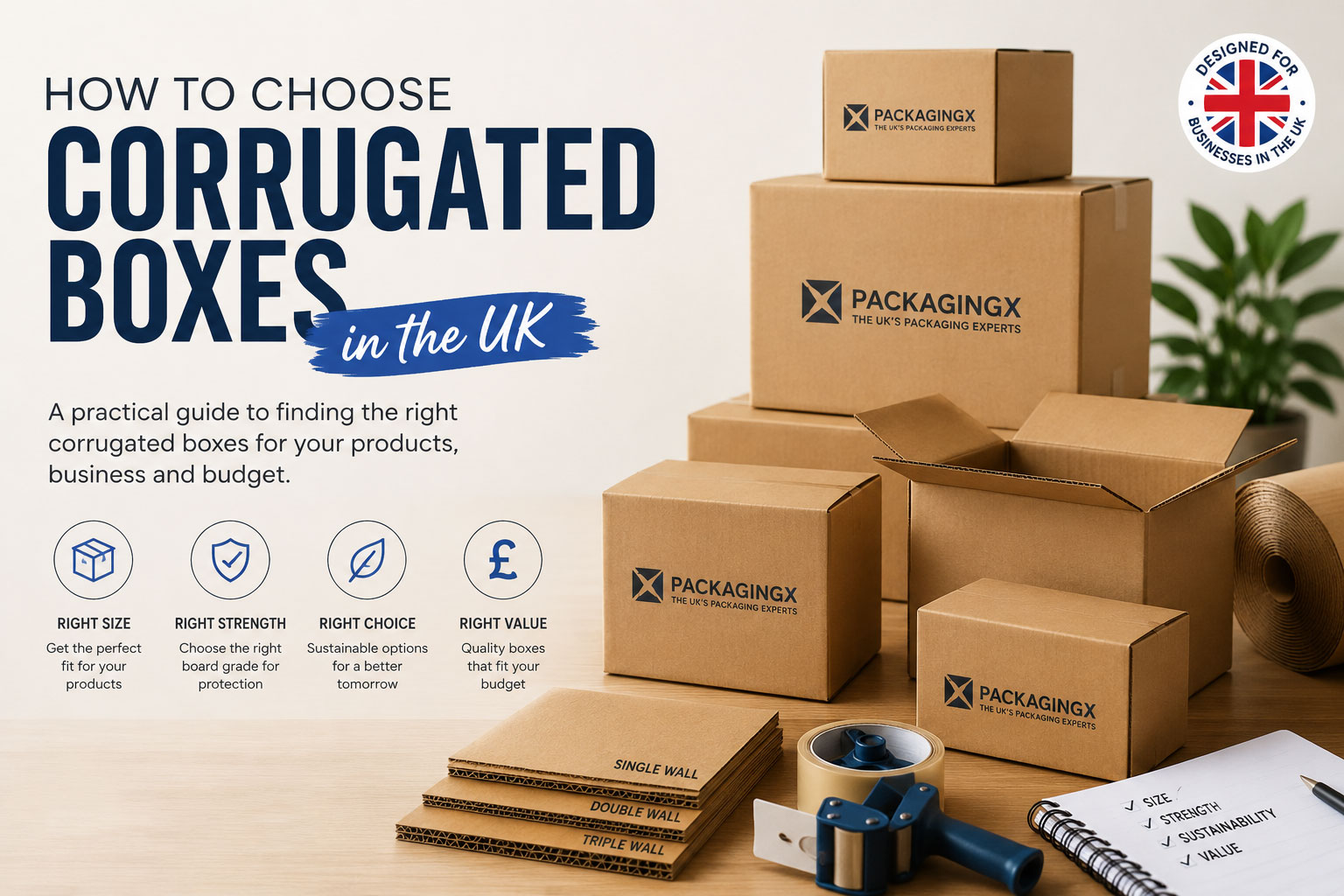
Most businesses think choosing a corrugated box is simple.
Pick a size. Place an order. Done.
But here’s what actually happens when you get it wrong. The box is too big, so the product shifts during transit and arrives damaged. Or the box is too weak, and it collapses under courier handling. Or the box is too plain, and the customer’s first impression of your brand is a brown box with no personality.
Any of those scenarios costs you money. And more importantly — they cost you customer trust.
Here’s the good news. Choosing the right corrugated box isn’t complicated once you know what to look at. Product size, weight, fragility, shipping method, box strength, printing, inserts, and order quantity — get those right and everything else falls into place.
According to Packaging Digest, businesses that match packaging to their product properly reduce damage-related returns by up to 30%. That’s not a small number when you’re shipping hundreds or thousands of orders a month.
In this guide, we’re going to walk through exactly how to choose the right corrugated box for your product — step by step, in plain language, without getting lost in technical packaging jargon.
Let’s get into it.
Quick Answer: How Do You Choose the Right Corrugated Box?
Start with your product size, weight, and fragility. Then think about how the product will be shipped, stored, or displayed.
Lightweight products may only need a single wall box. Heavier or fragile products may need double wall corrugated packaging, inserts, or extra cushioning. If your product is being shipped to customers, protection comes first. If it’s going on a shop shelf, presentation and printing matter too.
For custom packaging built around your product needs, explore custom corrugated boxes from PackagingX.
Why Getting This Right Actually Matters
Packaging is often the first physical thing your customer touches. And first impressions are hard to undo.
A box that arrives damaged makes your product feel cheap — even if the product itself is excellent. A box that’s oversized signals that your brand doesn’t pay attention to details. A box that’s too plain misses a real opportunity to make the customer feel something when they open it.
On the flip side, the right corrugated box protects the product during delivery, reduces returns and replacements, lowers the chance of damage, improves the unboxing experience, makes your brand look more professional, avoids wasted material, and helps control shipping and packaging costs.
That’s a lot of value sitting in a box. The goal is to choose packaging that fits the product, protects it properly, and supports the way your business sells.
Step 1: Measure Your Product Properly
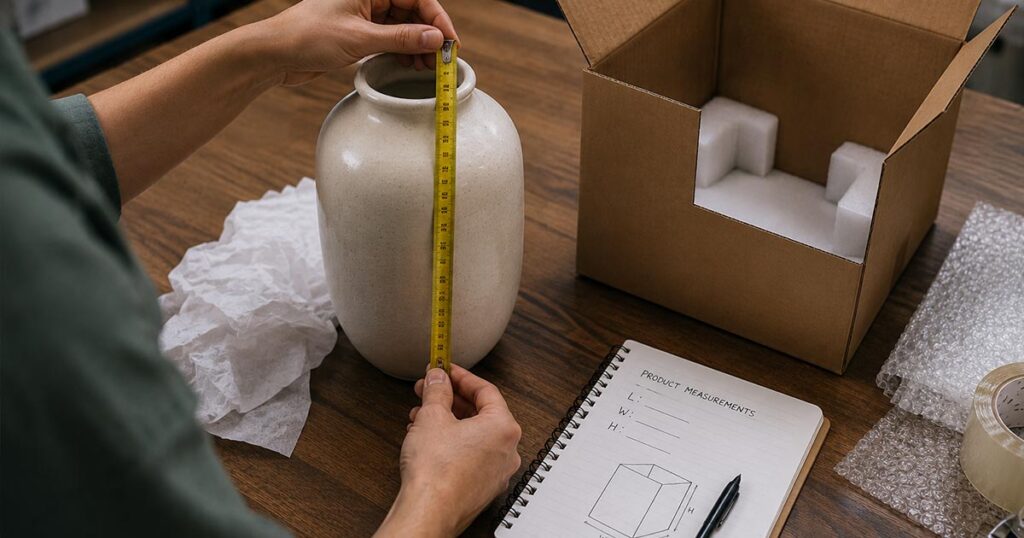
Before you look at a single box option, measure your product.
You need the length, width, and height. If your product has an unusual shape, measure the widest, longest, and tallest points. That prevents you from ordering a box that’s technically the right volume but the wrong shape.
Then think about what else needs to go inside the box alongside the product. Tissue paper, bubble wrap, inserts, dividers, product cards, labels, padding — all of these take up space. Your box needs to account for them.
Here’s the rule. A box should not be too tight and it should not be too large. Too tight means no room for protection. Too large means the product shifts around during delivery — which is one of the most common causes of damage during transit.
A right-sized corrugated box gives your product enough room for protection without wasting material or adding unnecessary shipping weight.
Step 2: Think About Product Weight
Product weight is one of the biggest factors in choosing corrugated packaging — and one of the most commonly underestimated.
Here’s a simple reference table:
| Product Type | Recommended Box Strength |
|---|---|
| Clothing, fabric items, small accessories | Single wall corrugated |
| Cosmetics, small gifts, light retail products | Single wall or mailer box |
| Candles, glass jars, bottles | Stronger corrugated with inserts |
| Electronics, heavy gift sets, bulk items | Double wall corrugated |
| Warehouse or stacked products | Double wall corrugated |
A lightweight product doesn’t always need the strongest box. But a heavy product should never go into weak packaging just to save a few cents per box. The wrong call here costs far more later — through damaged goods, customer complaints, and returns that eat into your margins.
For a full breakdown of board strengths, read our guide on single wall vs double wall corrugated boxes.
Step 3: Check How Fragile the Product Is
Weight and fragility are two different things — and both matter.
A product can be lightweight but extremely fragile. A glass perfume bottle doesn’t weigh much, but it needs significantly more protection than a folded T-shirt of the same weight.
Fragile products include glass jars, bottles, candles, ceramics, electronics, cosmetics in glass packaging, gift sets, food jars, and premium retail items.
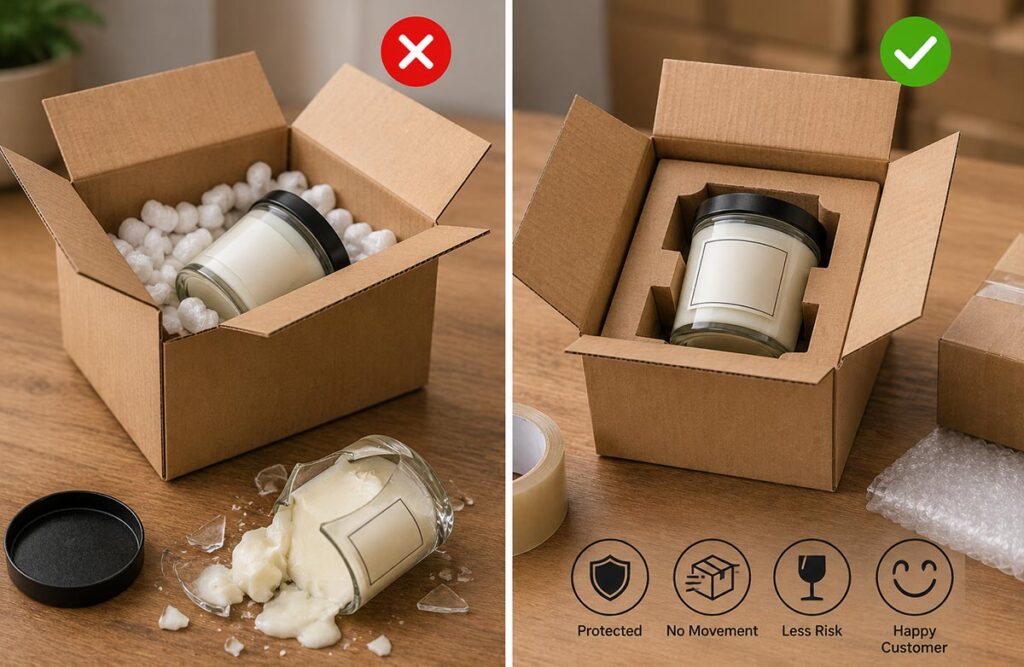
For fragile products, the box alone isn’t enough. The box needs to stop the item from moving inside during transit. That’s where inserts, dividers, and custom inner support come in.
Here’s a practical example. A candle may look fine sitting in a plain corrugated box. But during courier delivery — where parcels get stacked, dropped, and pushed around conveyor belts — that candle shifts. It cracks. It dents. It breaks. A custom insert holds it in place and eliminates that risk entirely.
If your product is fragile, don’t only think about the outside of the box. Think about what happens inside the box during delivery.
Step 4: Decide How the Box Will Be Used
The right box for courier delivery is not the same as the right box for a retail shelf. And the right box for a retail shelf is not the same as the right box for warehouse storage.
Ask yourself these questions before choosing a box style. Will the product be shipped? Will it sit on a retail shelf? Will it be stored in a warehouse? Will it be used for food delivery? Will it be part of a gift set? Will customers open it at home? Will boxes be stacked on top of each other?
| Use Case | Best Corrugated Box Type |
|---|---|
| Ecommerce delivery | Mailer boxes, postage boxes, shipping boxes |
| Retail display | Display boxes, shelf-ready boxes |
| Food packaging | Pizza boxes, bakery boxes, takeaway boxes |
| Gift packaging | Printed mailer boxes, gift-style corrugated boxes |
| Fragile products | Boxes with inserts or dividers |
| Storage | Strong corrugated storage or archive boxes |
If your business sells online, custom mailer boxes or corrugated mailer boxes work well for branded deliveries that make a strong impression at the customer’s door.
Step 5: Choose the Right Box Style
Corrugated boxes come in different styles — and each one is built for a different purpose.
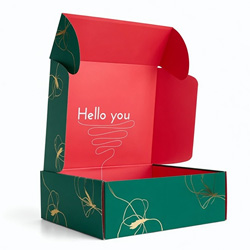
Mailer boxes are the go-to for ecommerce, subscription products, gifts, clothing, cosmetics, and small retail items. They open cleanly and give a much better unboxing experience than a standard brown shipping box. If your box reaches the customer directly, a mailer box is worth considering.
Shipping boxes are designed for protection above all else. They’re practical, strong, and built for courier handling. Best when product safety matters more than presentation.
Postage boxes work well for smaller products that need compact, secure packaging for postal or courier delivery. Explore custom postage boxes if you’re sending smaller items regularly.
Display boxes are for products that need to be seen — on a counter, shelf, or retail space. They prioritize visibility and presentation over shipping protection. For shelf-ready options, look at custom display boxes or retail boxes.
Food boxes need to be practical, safe, and easy to handle for the product type. Pizza boxes, bakery boxes, burger boxes, takeaway boxes, and cake boxes all have different structural requirements. Explore custom food packaging boxes for food-specific options.
Step 6: Choose Single Wall or Double Wall
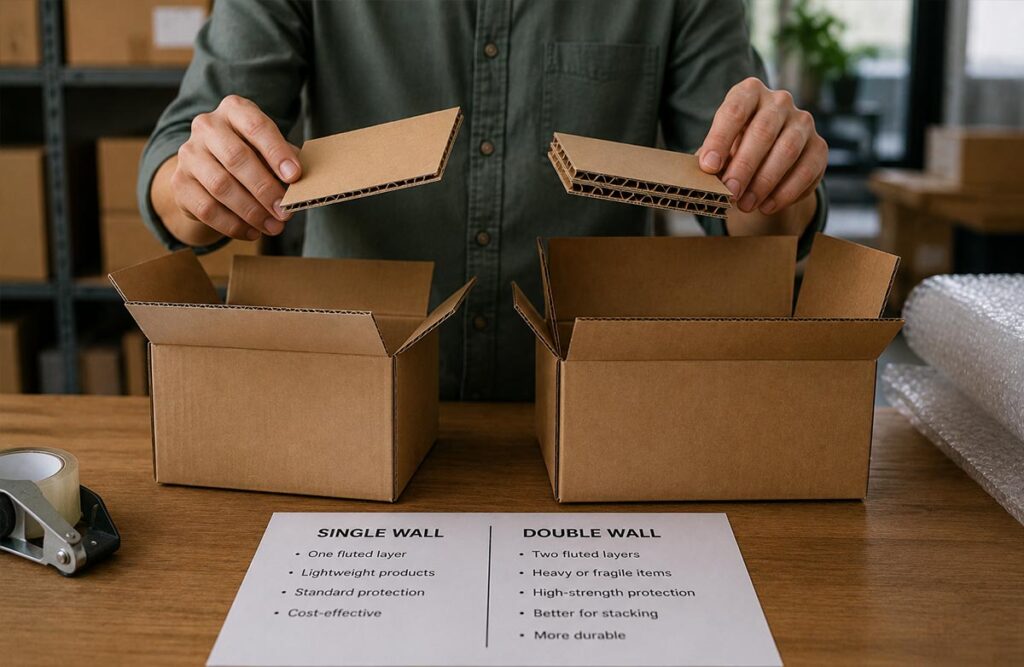
This is one of the most important decisions you’ll make — and it’s simpler than it sounds.
Single wall corrugated boxes have one fluted layer. They’re suitable for lighter products and general packaging where the product doesn’t need heavy-duty protection.
Double wall corrugated boxes have two fluted layers. They’re stronger, thicker, and far better for heavier, fragile, or stacked products.
Choose single wall if your product is lightweight, not fragile, needs standard ecommerce packaging, won’t be heavily stacked, and you want a cost-effective option.
Choose double wall if your product is heavy, fragile, high-value, going to be stacked, or facing a rough delivery journey where it needs serious structural support.
If you’re unsure, ask yourself one question. If this product gets damaged, how much does it cost you — in money, in replacements, and in customer trust? If that number is significant, go with the stronger box.
Step 7: Think About Printing and Branding
If your box reaches the customer directly, printing is not optional — it’s an opportunity.
A branded corrugated box can include your logo, brand colors, website, product name, QR code, social media handles, a thank-you message, handling instructions, and a recycling message.
For simple shipping, even a one-color logo print makes a real difference. For ecommerce and retail, a more fully branded design can transform the unboxing experience from forgettable to shareable.
Here’s something worth thinking about. According to Dotcom Distribution’s ecommerce study, 40% of consumers say they would share a photo of a product on social media if it came in branded or gift-like packaging. Your box is free marketing — if it looks good enough to photograph.
For retail display, printing matters even more. The box needs to catch attention, communicate the product clearly, and match your brand identity from across a store aisle.
Step 8: Use Inserts When Needed
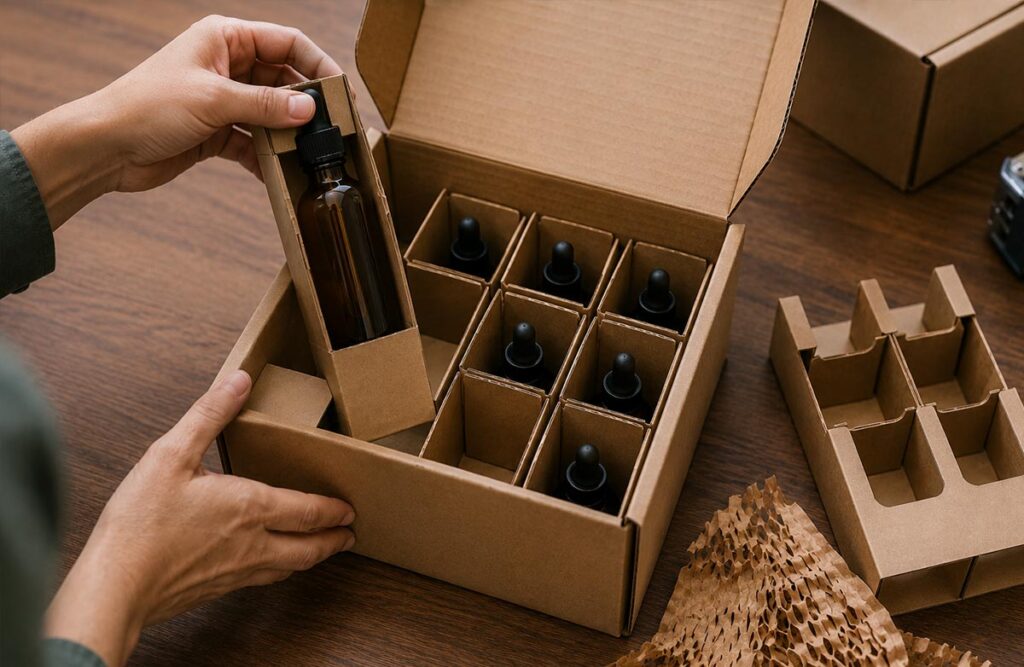
Inserts and dividers do one job — they stop the product moving inside the box during transit.
They’re most commonly used for bottles, candles, cosmetics, glass jars, electronics, gift sets, subscription boxes, and any order with multiple items in one box.
Yes, inserts add cost. But they reduce product damage, make the packaging look neater, and significantly improve the unboxing experience for the customer. For fragile or multi-item products, mailer boxes with inserts are almost always worth the extra investment.
Think of it this way. The cost of one damaged product — plus the return, the replacement, the shipping, and the bad review — almost certainly exceeds the cost of the insert that would have prevented it.
Step 9: Keep the Box Size Practical
Here’s a mistake more businesses make than you’d think choosing an oversized box because they assume bigger means safer.
It doesn’t. A box that’s too large creates more problems than it solves.
More empty space means more void fill. More void fill means more cost. More space inside means the product moves around more during transit which actually increases the risk of damage, not reduces it. And a large, poorly filled box looks unprofessional when the customer opens it.
A box that’s too small is also a problem no room for protection, and the product may be squeezed or stressed during packaging.
The best box size is close to the product size, with enough space for inserts or padding where genuinely needed. Right-sized packaging looks better, protects better, and costs less to ship. It’s one of the simplest improvements most businesses can make.
Step 10: Consider Your Order Quantity
Order quantity directly affects the price per box.
Small orders cost more per unit because setup and production costs are spread across fewer boxes. Larger orders reduce the cost per box sometimes significantly.
But ordering in bulk isn’t always the right call. Before committing to a large quantity, think about how many boxes you actually use each month, how much storage space you have, whether your design is final or might change, your available budget, any upcoming product launches, and whether you have seasonal demand peaks that affect your usage.
A practical order quantity gets you a better price without creating unnecessary stock that sits in a warehouse, takes up space, and potentially becomes outdated if your product or branding changes.
Simple Checklist Before You Order
Before placing any corrugated packaging order, run through these questions:
What is the exact product size? What is the product weight? Is the product fragile? Will the box be shipped? Will the box be stacked? Does the product need inserts? Does the packaging need printing? Is it for retail, ecommerce, food, or storage? Do you need single wall or double wall? What order quantity makes sense? Do you need a custom size? Is the design practical and easy to read?
If you can answer all of these clearly, you’re ready to order with confidence.
Cardboard or Corrugated: Which Should You Pick?
If your product is lightweight and mainly needs shelf presentation, regular cardboard packaging may be enough. It works well for small retail items, product sleeves, cosmetic boxes, and light packaging where the box isn’t going through courier delivery.
If your product needs shipping protection, storage strength, or better cushioning — corrugated is almost always the better choice.
Read our full comparison here: corrugated boxes vs cardboard boxes.
For a broader overview of corrugated packaging, read our complete guide to corrugated packaging boxes.
Common Mistakes to Avoid
Choosing the cheapest option: A cheap box saves money upfront. A damaged product costs you money, time, customer trust, and reviews you can’t take back.
Using one box for every product: A T-shirt and a glass candle have completely different packaging needs. Treat them differently.
Ignoring shipping conditions: Courier delivery is rough. Parcels get stacked, dropped, and pushed around. If your product is being shipped, choose packaging built to handle that reality.
Choosing the wrong size: Oversized boxes waste material and push up shipping costs. Tight boxes don’t protect properly. Neither is acceptable.
Forgetting the customer experience: For ecommerce brands especially, the box is part of the product experience. A clean, branded box makes your product feel more valuable before it’s even opened.
Final Thoughts
Here’s the bottom line.
Choosing the right corrugated box isn’t about finding the cheapest option or the biggest one. It’s about matching the box to the product — the weight, the fragility, the shipping journey, the customer experience, and the brand you’re trying to build.
Get that match right and you reduce damage, lower returns, improve the unboxing experience, and give your brand a more professional presence at every touchpoint.
Get it wrong and you pay for it — in damaged products, unhappy customers, and packaging that works against you instead of for you.
For custom packaging built around your exact product size, strength, and branding needs, explore corrugated packaging boxes from PackagingX and request a free quote today.
FAQs
How do I choose the right corrugated box size?
Measure your product’s length, width, and height, then allow enough space for inserts or protective material if needed. Avoid boxes that are too large — they increase shipping costs and allow the product to move around during transit.
What corrugated box is best for shipping?
For lightweight products, single wall corrugated boxes are usually enough. For heavier, fragile, or high-value products, double wall corrugated boxes or boxes with inserts are the better choice for shipping.
Do fragile products need inserts?
Yes. Fragile products need inserts, dividers, or extra internal support to stop them moving inside the box during delivery. Inserts are particularly important for candles, glass jars, bottles, cosmetics, electronics, and gift sets.
Are custom corrugated boxes better than standard boxes?
Custom corrugated boxes are better when you need the box to fit your product properly, support your branding, or provide specific protection. Standard boxes can work for simple packaging needs, but they often don’t fit or protect the product as well.
Should I choose single wall or double wall corrugated boxes?
Choose single wall for lighter, non-fragile products. Choose double wall for heavier, fragile, valuable, or stacked products that need stronger protection during delivery or storage.
Can corrugated boxes be printed with my logo?
Yes. Corrugated boxes can be printed with your logo, brand colors, product details, QR codes, handling instructions, recycling messages, and customer notes. Printed boxes make your packaging look more professional and improve the overall customer experience.