

 Corrugated
 Cardboard
 Kraft
Kraft Rigid
Rigid Folding Carton Boxes
 Tuck End Boxes
 Auto Bottom Boxes
 Tuck Top Boxes
 Display Lid Boxes
 CBD Oil Boxes
 Hemp Oil Boxes
 CBD Tincture Boxes
 E-Liquid Boxes
 Vape Cartridge
 See all products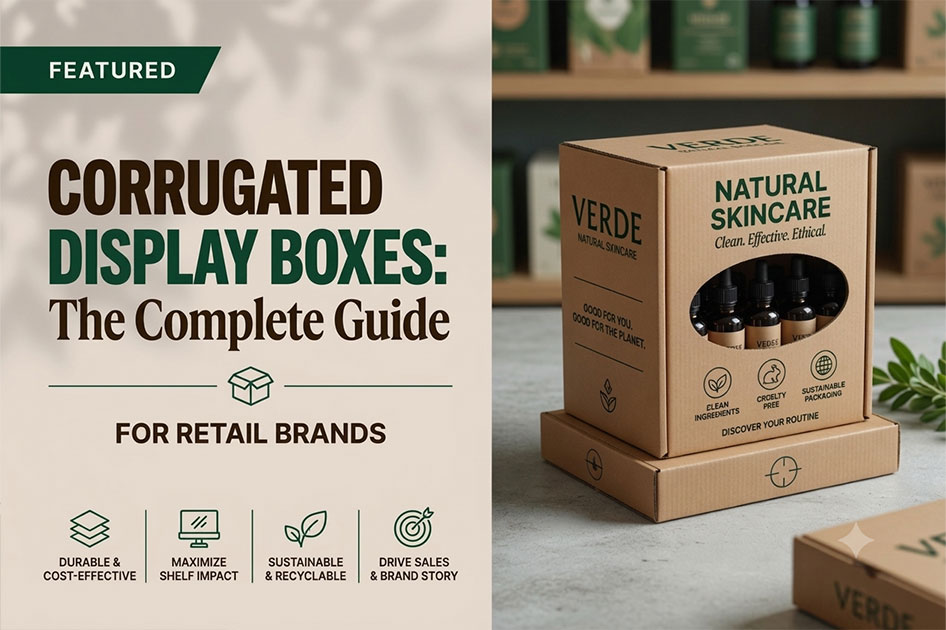
Here’s something most retail brands underestimate.
A customer in a retail store makes a buying decision in an average of 7 seconds. Seven seconds to notice your product, understand what it is, and decide whether to pick it up.
That’s not enough time to read a paragraph. It’s barely enough time to register a product exists.
And if your product is sitting loosely on a shelf, mixed in with competitors, with no clear visual structure around it — those seven seconds are gone before you even had a chance.
That’s exactly the problem corrugated display boxes solve.
According to the Point of Purchase Advertising International (POPAI), 82% of buying decisions are made in-store — not before the customer walks in. That means the packaging and presentation at the point of sale has a direct impact on whether your product gets picked up or passed over.
In this guide, we’re going to break down exactly what corrugated display boxes are, where they work best, how to choose the right style, and what most brands get wrong when ordering them.
Let’s get into it.
Quick Answer: What Are Corrugated Display Boxes?
Corrugated display boxes are strong paper-based boxes designed to hold and present products in retail spaces. They’re used on counters, shelves, point-of-sale areas, exhibitions, and promotional displays.
They combine the structural strength of corrugated packaging with the visibility and branding needed for retail presentation. For custom retail display packaging, explore custom display boxes or custom corrugated boxes from PackagingX.
Why Display Boxes Matter More Than Most Brands Realize
In retail, customers make quick decisions. If the product is hidden, messy, or difficult to understand at a glance — it gets ignored. It doesn’t matter how good the product is if nobody stops to look at it.
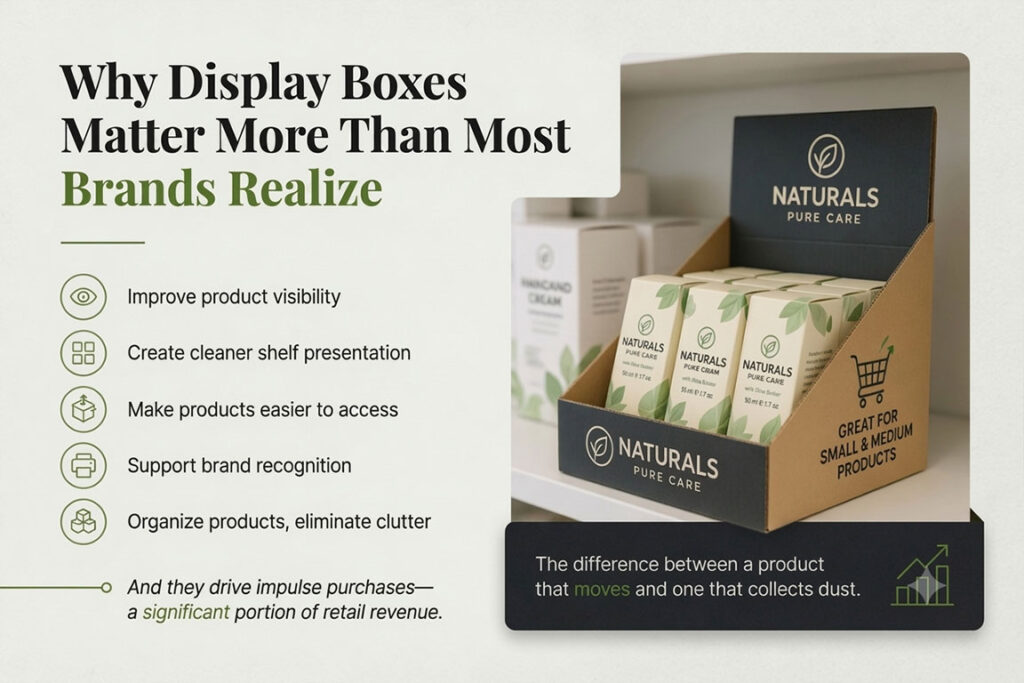
A good display box fixes that. It makes your product visible, keeps it organized, and gives customers a reason to interact with it.
Here’s what corrugated display boxes actually do for your brand in a retail environment. They improve product visibility. They create a cleaner, more professional shelf presentation. They make products easier for customers to access. They support brand recognition through printed design. They organize products so they don’t look messy or random. And they support impulse purchases — which account for a significant portion of retail revenue.
For small and medium-sized products especially, a display box can be the difference between a product that moves and a product that collects dust.
What Makes Corrugated Display Boxes Different from Shipping Boxes?
This is a question worth answering clearly — because a lot of businesses confuse the two.
A shipping box is designed to protect a product during delivery. A display box is designed to present a product in a retail environment. They look different, they’re built differently, and they serve completely different purposes.
| Feature | Shipping Boxes | Corrugated Display Boxes |
|---|---|---|
| Main purpose | Product protection during delivery | Product presentation in retail |
| Design focus | Strength and safety | Visibility and branding |
| Common use | Ecommerce, courier, storage | Counters, shelves, POS displays |
| Printing | Optional | Usually important |
| Product access | Closed box | Open or easy-access style |
Both are useful. In fact, many products use both — one box for shipping and a separate display box for retail presentation. They’re not competing options. They’re different tools for different jobs.
Where Are Corrugated Display Boxes Used?
Corrugated display boxes show up anywhere products need to be visible, easy to reach, and neatly arranged.
The most common locations are retail shelves, checkout counters, supermarket displays, pharmacy counters, cosmetic shops, food shops, gift shops, trade shows, exhibitions, promotional stands, and product launch displays.
They’re especially effective for small products that look messy when placed loosely on a shelf. A neat display box groups them together, creates visual structure, and makes the whole product category look more intentional.
Products That Work Best in Corrugated Display Boxes
Corrugated display boxes work across a wide range of product categories. Here’s where they’re used most often.
For food brands — snacks, chocolates, bakery items, confectionery, small food boxes, seasonal food displays, and takeaway promotions. If you sell food products, explore custom food packaging boxes for product-specific options.
For cosmetic brands — lip balms, small skincare products, creams, beauty accessories, and skincare tubes. A well-designed display box makes cosmetic products look more trustworthy and premium — even before the customer picks one up.
For gift and promotional products — gift sets, seasonal offers, promotional bundles, event giveaways, and product launch displays. For gift-focused products, compare options with custom gift boxes.
For retail and accessories — supplements, stationery, small electronics accessories, toys, sachets, and promotional items.
The right display box depends on product size, weight, quantity, and how the customer will interact with it. A small cosmetic item needs a neat counter display. A snack product may need a larger shelf-ready display unit.
The Three Main Types of Corrugated Display Boxes
Not all display boxes are the same. Here’s a breakdown of the most common types and when to use each one.
Counter display boxes are smaller display units placed near checkout areas or service counters. They’re designed for impulse-buy products — the things customers grab without planning to. Lip balms, chocolates, small snacks, sachets, gift cards, mini cosmetics, and promotional accessories all work well here. Counter display boxes need to be compact, visually clear, and immediately understandable. A customer might only see it for two or three seconds before their transaction ends.
Shelf display boxes keep products organized on retail shelves instead of placing individual items loosely. They’re useful for packaged snacks, cosmetics, supplements, promotional products, and small retail accessories. A good shelf display box holds the product securely while staying open enough for customers to see and access items easily. It also makes restocking faster and cleaner for the retailer — which makes you easier to work with as a supplier.
Shelf-ready packaging is designed to move from delivery straight onto the retail floor with minimal handling. The box itself becomes the display unit. This saves time for retailers, speeds up restocking, protects products during transport, and keeps the display looking consistent. For brands selling through shops, stockists, or promotional spaces, shelf-ready corrugated packaging is worth considering from the start.
Corrugated vs Cardboard Display Boxes: Which Should You Choose?
Both corrugated and cardboard display boxes are paper-based, but they’re built differently and suit different situations.
| Feature | Cardboard Display Boxes | Corrugated Display Boxes |
|---|---|---|
| Best for | Lightweight retail products | Stronger retail display needs |
| Strength | Basic to medium | Stronger |
| Print surface | Smooth, clean print | Good for branded display |
| Product support | Better for light items | Better for heavier items |
| Use case | Small shelf packaging | Counter, shelf, POS displays |
If your product is light and only needs basic display packaging, cardboard may be perfectly sufficient. If the product is heavier, needs to survive transport before becoming a display, or will be used for an extended period — corrugated is almost always the better choice.
Read our full material comparison in our guide on corrugated boxes vs cardboard boxes.
Printing and Branding: Why It Matters More for Display Boxes
For shipping boxes, printing is optional. For display boxes, it’s essentially mandatory.
Your display box is visible to customers in a retail environment. It’s competing with every other product on the same shelf, counter, or display stand. Without clear, branded printing, it disappears into the background.
A well-printed display box can include your logo, brand colors, product name, key benefits, product image, offers or promotions, QR code, website, social media handles, a recycling message, and a short product description.
But here’s the important thing. Don’t try to include all of that at once.
Retail customers don’t read display boxes — they scan them. The front panel needs to communicate the most important information in a single glance. Brand name. Product type. Main message. That’s it. Everything else is secondary.
Here’s a practical design principle worth following: if a customer standing two meters away can’t immediately understand what the product is and who makes it, the design needs to be simplified.
To learn more about printing options, read our guide on printed corrugated boxes.
How to Design a Display Box That Actually Works
Good design isn’t about making the box look busy. It’s about making it work harder in the retail environment.
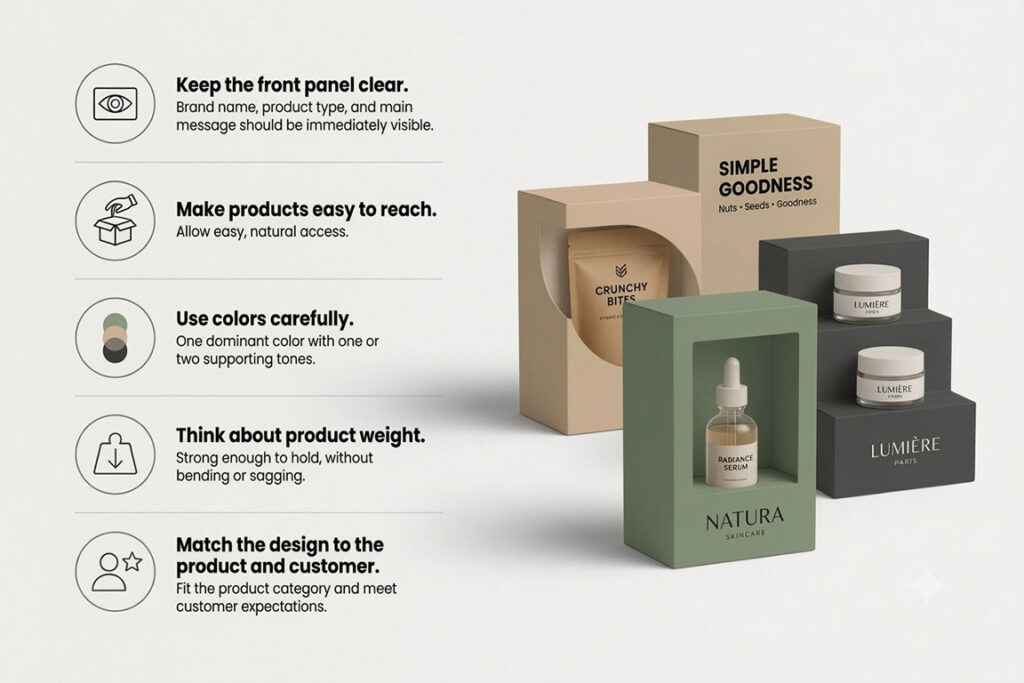
Keep the front panel clear. The brand name, product type, and main message should be immediately visible. Don’t make customers search for the information they need.
Make products easy to reach. If customers have to struggle to pick up a product, many of them simply won’t. The box needs to allow easy, natural access.
Use colors carefully. Brand colors build recognition, but too many colors make the display look cluttered and unprofessional. Most effective display boxes use a dominant color with one or two supporting tones.
Think about product weight. The box must hold all the products without bending, sagging, or losing its shape over time. A collapsed display box does serious damage to how a product is perceived in store.
Match the design to the product and customer. A luxury cosmetic display needs a completely different visual approach than a snack food display. The design should fit the product category and meet the customer’s expectations for that type of product.
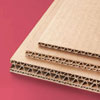
Single Wall vs Double Wall Corrugated Boxes
What Affects the Cost of Corrugated Display Boxes?
Like all custom packaging, the price depends on how customized the display box is.
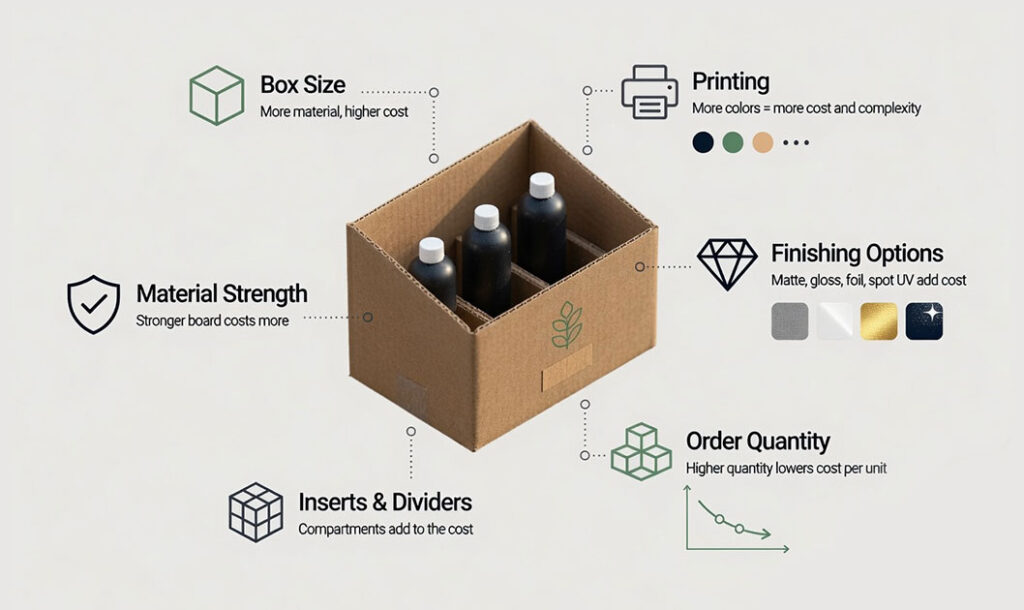
Box size is one of the biggest factors — larger display boxes use more material and cost more. Material strength also matters — stronger corrugated board costs more but may be necessary for heavier products or longer-term displays.
Printing adds cost, but it’s usually worth it for display packaging. Simple one-color logo printing costs less than full-color artwork across the whole box. The number of colors affects complexity and setup time. Finishing options like matte, gloss, foil, or spot UV add a premium feel but also add cost.
If your display box needs inserts, compartments, or dividers to hold products neatly, those add to the price too. And as with all custom packaging, order quantity has a significant impact — bulk orders reduce the cost per unit.
If you’re ordering in larger quantities, read our guide on custom corrugated boxes wholesale to understand how bulk pricing works.
Display Boxes vs Retail Boxes: What’s the Difference?
These two terms get confused often — so let’s clear it up.
Retail boxes usually hold individual products. A single skincare item comes in its own retail box. Display boxes hold multiple products together for shelf or counter presentation. Multiple skincare items sit inside a counter display box.
They work together, not as alternatives. The retail box presents the individual product. The display box presents the group of products in the retail environment. Both can carry your brand, your colors, and your messaging — just at different scales.
If you need individual product packaging, explore retail boxes alongside display options.
Corrugated Display Boxes for Ecommerce Brands
Here’s something ecommerce brands often don’t think about until it’s too late.
If you ever plan to sell through retail partners, pop-ups, exhibitions, market stalls, or product events — you need display packaging that’s different from your shipping packaging.
Your corrugated mailer box is designed for a customer opening an order at home. A display box is designed for a customer browsing a busy retail space. They serve completely different experiences, and the same box rarely does both jobs well.
An online candle brand selling at a market stall needs a display box that groups products attractively and makes the collection immediately understandable. The mailer box used for shipping just doesn’t do that job.
For ecommerce delivery packaging, read our guide on corrugated shipping boxes. For retail and event display, explore custom display boxes separately.
Simple Checklist Before Ordering
Before placing an order for corrugated display boxes, run through these questions.
What product will the box display? How many items will sit inside? Will it be used on a counter or a shelf? Does the box need printing? What is the most important message customers should see first? Does the box need inserts or compartments? How heavy are the products? Will the box need to survive transport before becoming a display? What quantity do you need? Does the design match your brand identity and product category?
If you can answer all of these clearly, you’re ready to order with confidence.
Common Mistakes to Avoid
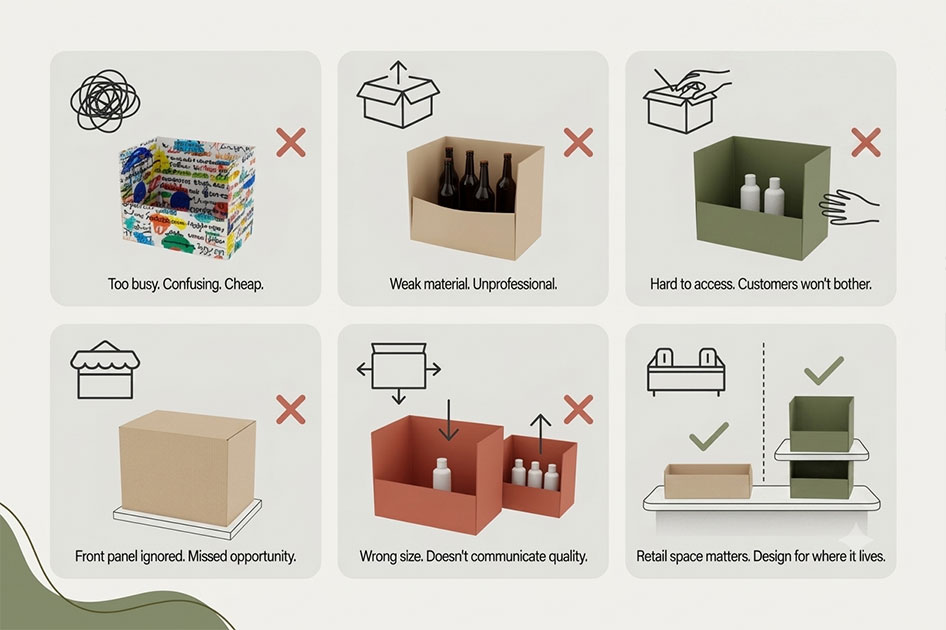
Making the design too busy: Too much text, too many colors, and too much artwork confuse customers and make the display look cheap. Keep it clean.
Choosing weak material: If the display box bends, sags, or collapses under the weight of the products, it makes your brand look unprofessional in store. Strength matters even for display packaging.
Ignoring product access: If customers can’t easily pick up the product, many of them won’t bother. The box should make interaction natural and effortless.
Forgetting the front panel: The front panel is the most visible part of the display. It’s what customers see first. Treat it as prime real estate for your brand message.
Using the wrong size: A box that’s too big looks empty. A box that’s too small makes products look cramped. Neither communicates quality.
Not thinking about the retail space: A counter display needs a completely different size and design than a shelf display. Know where the box will live before you design it.
Final Thoughts
Here’s the bottom line.
Corrugated display boxes are one of the most practical tools a retail brand has for improving product visibility, organization, and presentation at the point of sale. They don’t just hold products — they present them, protect them, and communicate your brand in an environment where customers are making fast decisions.
With 82% of buying decisions made in-store, the brands that invest in better retail presentation consistently outperform the ones that treat display packaging as an afterthought.
Get the design right. Choose the right material strength. Make products easy to see and easy to access. And make sure the most important message on the box is visible in under three seconds.
Do that, and your display box stops being just a container — and starts being a sales tool.
For custom display packaging built around your product size, retail environment, and brand identity, explore custom display boxes or corrugated packaging boxes from PackagingX and request a free quote today.
FAQs
What are corrugated display boxes used for?
Corrugated display boxes are used to present products in retail spaces, counters, shelves, exhibitions, and point-of-sale areas. They help products stay organized, visible, and easy for customers to access and purchase.
Are corrugated display boxes strong enough for retail use?
Yes. Corrugated display boxes are stronger than basic paperboard display boxes because of their fluted inner layer. This gives them better structural support for holding products over extended retail periods.
Can corrugated display boxes be printed?
Yes. Corrugated display boxes can be printed with logos, brand colors, product names, offers, QR codes, and other details. For display packaging especially, printing is important — it’s what makes your product visible and recognizable in a busy retail environment.
What products work best in corrugated display boxes?
They work well for snacks, cosmetics, candles, small gifts, promotional products, supplements, accessories, stationery, and other small to medium-sized retail products where organization and visibility matter.
What’s the difference between display boxes and retail boxes?
Retail boxes usually hold individual products. Display boxes hold multiple products together for shelf or counter presentation. Both can be used together — the retail box presents the single item, the display box presents the group.
Can e-commerce brands use corrugated display boxes?
Yes. Ecommerce brands can use corrugated display boxes for pop-ups, retail partnerships, exhibitions, product launches, and market stalls. For standard shipping, corrugated mailer or shipping boxes are better suited to that job.