



 Corrugated
 Cardboard
 Kraft
Kraft Rigid
Rigid Folding Carton Boxes
 Tuck End Boxes
 Auto Bottom Boxes
 Tuck Top Boxes
 Display Lid Boxes
 CBD Oil Boxes
 Hemp Oil Boxes
 CBD Tincture Boxes
 E-Liquid Boxes
 Vape Cartridge
 See all products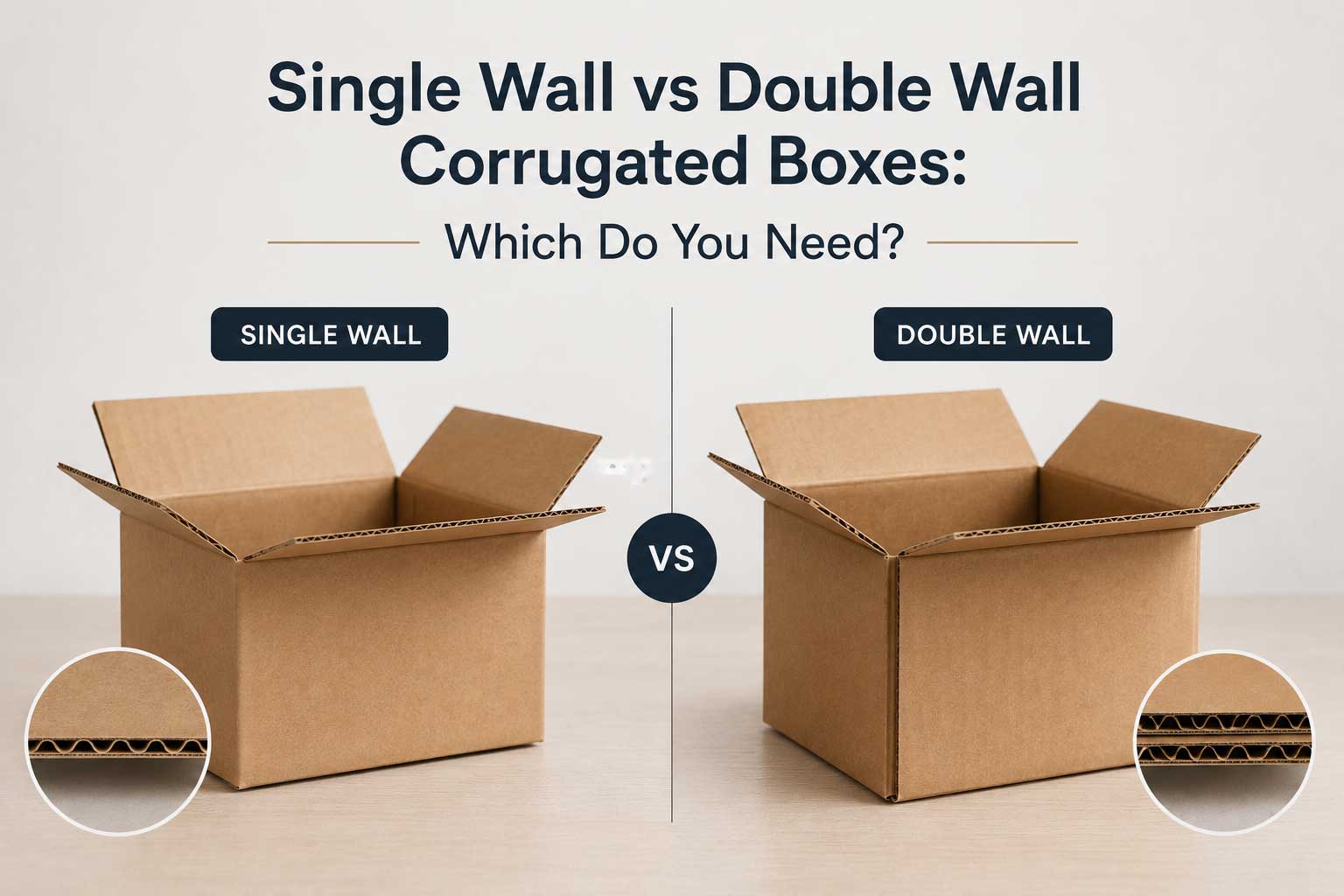
Did you know that 11% of all packages delivered in the US arrive damaged?
That’s not a supplier problem. That’s not a courier problem.
Most of the time — it’s a packaging problem.
And one of the most common causes? Businesses choosing the wrong box strength for their product. Either they go too light and the box fails under pressure, or they go too heavy and end up wasting money on material and shipping weight they didn’t need.
Here’s the good news. The fix is simpler than you think.
Single wall corrugated boxes work well for lighter, everyday products. Double wall corrugated boxes are the better call for heavier, fragile, or high-value items that need serious protection through transit and storage.
But knowing *which category your product falls into* that’s where most people get stuck.
And it matters more than you’d think. According to Forbes, a single bad delivery experience is enough to lose a customer for good. In a market where repeat buyers are everything, the box your product ships in isn’t just packaging — it’s part of the experience.
In this guide, we’re going to break down the real difference between single wall and double wall corrugated boxes, where each one works best, and exactly how to choose the right one for your product without overcomplicating it.
Let’s get into it.
Single Wall vs Double Wall Corrugated Boxes: Which One Does Your Product Actually Need?
You’re about to order custom boxes for your product.
You’ve found a supplier. You’ve got your dimensions ready. And then you hit a question that stops most people cold:
Single wall or double wall?
It sounds simple. But pick the wrong one and you’re either overspending on packaging you don’t need, or watching customer complaints pile up because your boxes couldn’t handle shipping.
Let me break it down for you.
What Are Single Wall Corrugated Boxes?
Single wall corrugated boxes are exactly what they sound like.
One fluted layer. Two flat liner sheets on either side. That’s it.
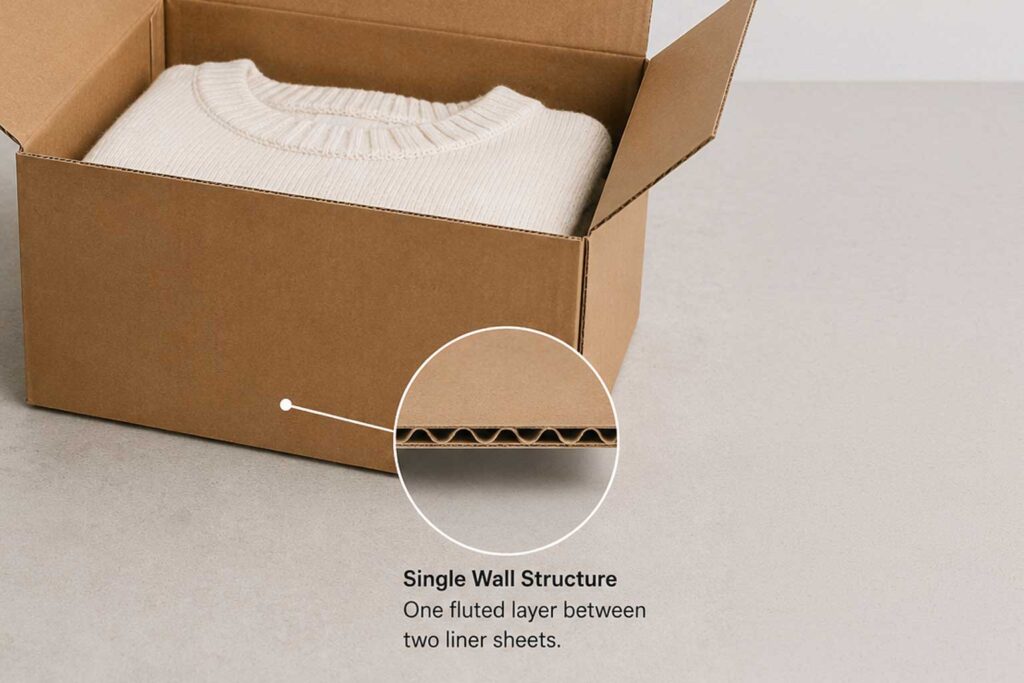
The result is a lightweight, cost-effective box that works well for a huge range of everyday products. We’re talking clothing, small skincare items, accessories, subscription boxes, gifts, and general retail orders.
Here’s why brands love them: they’re affordable, easy to store flat, and strong enough for most standard shipping situations.
But, and this is important, they do have a ceiling.
If your product is heavy, fragile, or going to spend a lot of time being thrown around in a courier van, single wall may not cut it. For lighter, everyday items though? It’s usually more than enough.
What Are Double Wall Corrugated Boxes?
Now let’s talk double wall.
Double wall corrugated boxes have two fluted layers and three liner sheets. That extra layer makes a real difference the box is noticeably thicker, stronger, and far better at absorbing pressure and impact.
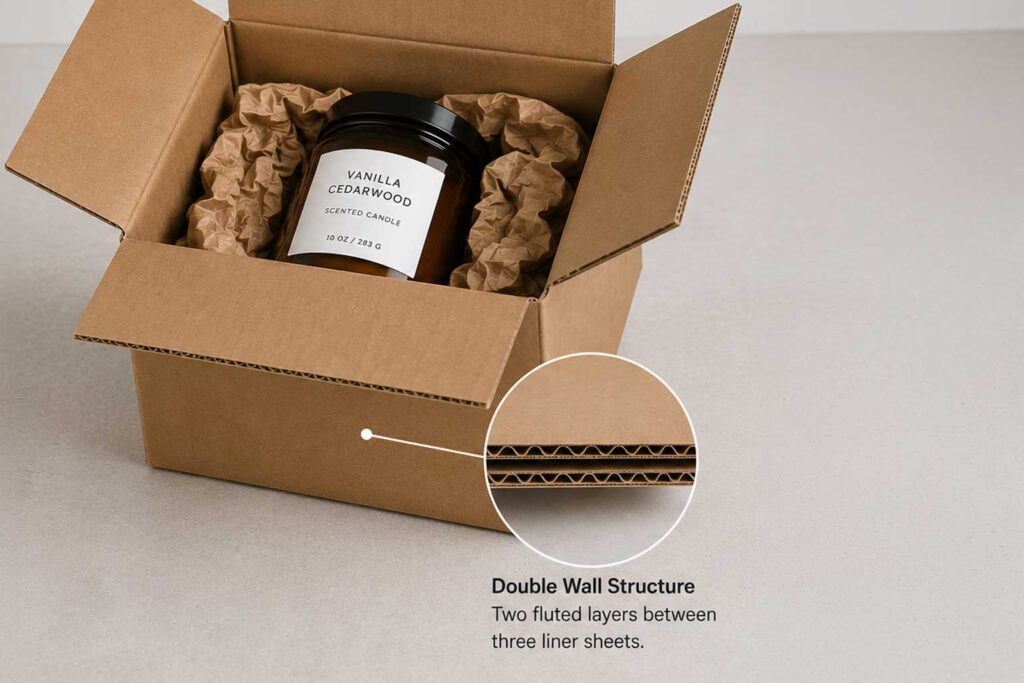
Think about the kind of products that need this level of protection. Glass bottles. Candles. Electronics. Bulk industrial orders. Anything that’s going to sit in a warehouse, get stacked on a pallet, or travel long distances before reaching your customer.
Yes, double wall boxes cost more upfront. But here’s the thing one damaged shipment, one bad review, one return can cost you far more than the difference in box price. When protection matters, double wall pays for itself.
Single Wall vs Double Wall: The Real Difference
Here’s the simplest way to think about it.
Single wall = one fluted layer. Double wall = two fluted layers.
That one extra layer is what separates them. It gives double wall boxes more thickness, more strength, and more resistance to the kind of pressure that happens during real-world shipping.
Single wall is built for lighter, non-fragile products where keeping costs down matters. Double wall is built for when protection is the priority heavier items, fragile goods, and anything facing tough transit conditions.
That’s it. Simple as that.
Which One Is Stronger?
Double wall. Every time.
The second fluted layer adds serious structural support. Stack boxes on top of it, run it through a courier network, ship it across the country double wall handles it better.
If you’re selling glassware, electronics, candles, heavy food items, or high-value gift sets, don’t cut corners here. The upgrade is worth it.
Single wall still performs well for lighter products. But follow this simple rule:
The heavier or more fragile your product, the stronger your box needs to be.
Write that down. It’ll save you a lot of headaches.
Which One Is Better for Shipping?
Here’s what most people don’t think about.
Shipping is brutal on boxes. Your parcel gets stacked under heavier items. It gets dropped. It gets pushed along conveyor belts. It gets squeezed into tight delivery vans with dozens of other packages.
A box that’s too weak for your product isn’t just a packaging problem it’s a customer experience problem.
So here’s how to think about it:
Going single wall? Make sure your product is lightweight, non-fragile, and not traveling too far. Clothing, small accessories, basic ecommerce orders single wall handles these comfortably.
Going double wall? You’re shipping something heavier, more delicate, or higher in value. Glass jars, electronics, bulk orders, long-distance shipments this is where double wall earns its place.
| Product Type | Recommended Box |
|---|---|
| Clothing & Apparel | ✅ Single Wall |
| Small Accessories | ✅ Single Wall |
| Standard Ecommerce Orders | ✅ Single Wall |
| Glass Bottles & Jars | ✅ Double Wall |
| Electronics | ✅ Double Wall |
| Bulk Orders | ✅ Double Wall |
| Long-Distance Shipments | ✅ Double Wall |
And if you really want to get this right, don’t just pick a standard box size off a shelf. Get your corrugated boxes custom-made around your actual product dimensions and shipping requirements. A box that fits properly protects better, wastes less material, and costs less to ship.
Bottom line: Match the box to the product, not the other way around.
Which One Is Better for Ecommerce?
Both single wall and double wall boxes can work for ecommerce, but it depends on the product.
Single wall boxes are good for light ecommerce products that do not need heavy protection. These may include clothing, beauty items, small gifts, accessories, and subscription products.
Double wall boxes are better when the ecommerce order includes fragile, heavy, or premium products. If a damaged parcel can lead to refunds, complaints, or bad reviews, stronger packaging is usually worth it.
For ecommerce brands, packaging is not only about protection. It also affects the customer’s first impression. A strong and well-designed box can make the delivery feel more professional.
Depending on your product, you may choose:
- Custom mailer boxes for branded ecommerce deliveries
- Corrugated mailer boxes for protective mailer-style packaging
- Mailer boxes with inserts for fragile or multi-item products
- Custom postage boxes for smaller delivery packaging
Which One Is Better for Storage?
Double wall corrugated boxes are usually better for storage if the products are heavy or stacked.
In warehouses, stockrooms, and offices, boxes may sit for weeks or months. They may also be stacked on top of each other. If the lower boxes are not strong enough, they can bend, crush, or lose shape.
Single wall boxes can be fine for light storage. But for heavier items, bulk stock, documents, or products that need to stay protected for longer, double wall can be a safer option.
For simple product storage, single wall may be enough. For warehouse storage or stacked boxes, double wall is usually better.
Which One Is Better for Retail Packaging?
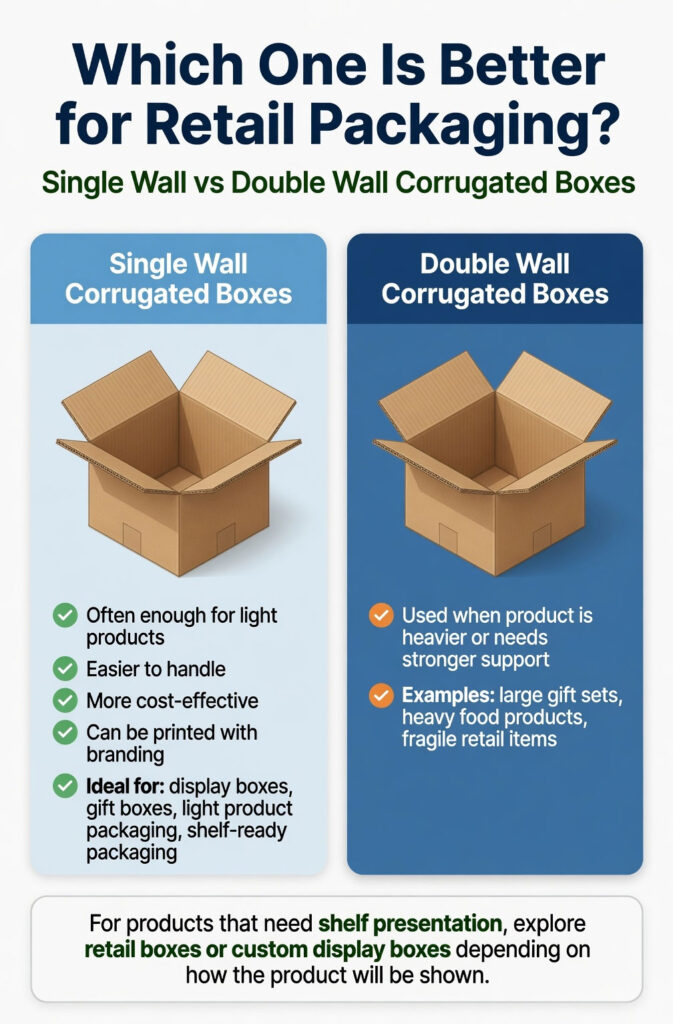
For retail packaging, single wall corrugated boxes are often enough when the product is light.
They are easier to handle, more cost-effective, and can still be printed with branding. Single wall boxes can work well for display boxes, gift boxes, light product packaging, and shelf-ready packaging.
Double wall boxes may be used in retail when the product is heavier or needs stronger support. For example, if you are packaging large gift sets, heavy food products, or fragile retail items, double wall may be useful.
For products that need shelf presentation, you can also explore retail boxes or custom display boxes depending on how the product will be shown.
Which One Costs More?
Double wall corrugated boxes usually cost more than single wall boxes because they use more material.
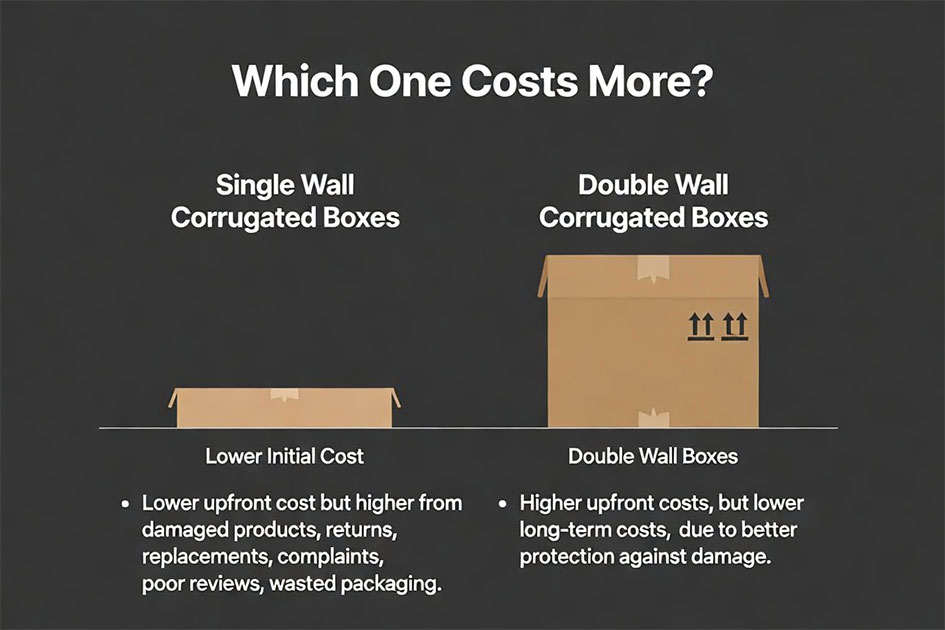
However, the cheapest option is not always the best option.
If a single wall box does not protect your product properly, you may end up paying more through:
- Damaged products
- Returns
- Replacement orders
- Customer complaints
- Poor reviews
- Wasted packaging
- Extra support material
Single wall boxes are more affordable and work well for many lighter products. Double wall boxes cost more, but they can save money in the long run if your product needs extra protection.
The best choice is not simply the cheapest box. It is the box that protects your product properly without wasting material or budget.
When Should You Use Single Wall Corrugated Boxes?
Let’s keep this simple.
Single wall corrugated boxes are the right call when your product is light, easy to handle, and doesn’t need heavy-duty protection to survive the journey to your customer.
Think clothing. Small cosmetics. Lightweight food items. Accessories. Subscription boxes. Retail products. Basic ecommerce orders.
If your product fits into one of those categories, single wall is probably all you need. It gives you real strength more than basic cardboard without the extra cost or weight that comes with a thicker box.
And in business, not overspending on packaging is just as smart as not underspending on it.
When Should You Use Double Wall Corrugated Boxes?
This is where things shift.
Double wall corrugated boxes exist for one reason when your product genuinely needs more protection than a single layer can offer.
We’re talking heavy products. Fragile items. Glass bottles and jars. Candles. Electronics. Bulk orders. Large gift sets. Industrial goods. Anything being stored in a warehouse, stacked on pallets, or shipped over long distances.
Here’s the thing most brands don’t think about until it’s too late: product damage doesn’t just cost you money on replacements and returns. It costs you customer trust. And that’s a lot harder to recover from than a slightly higher box cost.
If your product falls into any of those categories above, double wall isn’t an upgrade it’s a necessity.
Do You Always Need Double Wall Boxes?
No. And this is where a lot of businesses get it wrong.
There’s a common assumption that stronger always means better. So brands default to double wall packaging across the board thinking they’re playing it safe.
But here’s what actually happens. You end up spending more on material you don’t need. Your packaging gets heavier than it needs to be. Your shipping costs go up. And none of it adds any real value for your customer.
The smarter move is to match the box strength to what your product actually needs. Not what feels safer. Not what looks more impressive. What the product actually needs.
So before you decide, ask yourself these questions:
Is the product heavy? Is it fragile? Will it be shipped? Will it be stacked? Is it high-value? Will it go through courier handling? Does it need inserts or extra internal support?
If you’re saying yes to most of those double wall is the right call. If you’re saying no to most of them — single wall will do the job, and do it well.
Simple rule: let the product tell you what it needs. Then choose accordingly.
How to Choose the Right Corrugated Box Strength
Choosing between single wall and double wall doesn’t have to be complicated.
Run through these two quick checklists and you’ll have your answer in under a minute.
Go with single wall corrugated boxes if:
Your product is lightweight. It’s not fragile. You need standard ecommerce packaging that won’t break the bank. The box isn’t going to be heavily stacked. And the delivery journey is straightforward — point A to point B without too many stops in between.
Go with double wall corrugated boxes if:
Your product is heavy, fragile, or expensive. The box will be stacked. It’s going through courier handling or long-distance shipping. You need safer storage or bulk handling. Basically — if there’s any real risk of damage, double wall is worth it.
And if you want to go deeper on corrugated packaging, we’ve put together a complete guide to corrugated packaging boxes that covers everything you need to know. We’ve also broken down the material differences in our corrugated boxes vs cardboard boxes guide — worth a read if you’re still deciding on the right material altogether.
The Mistake Most Businesses Make Without Realizing It
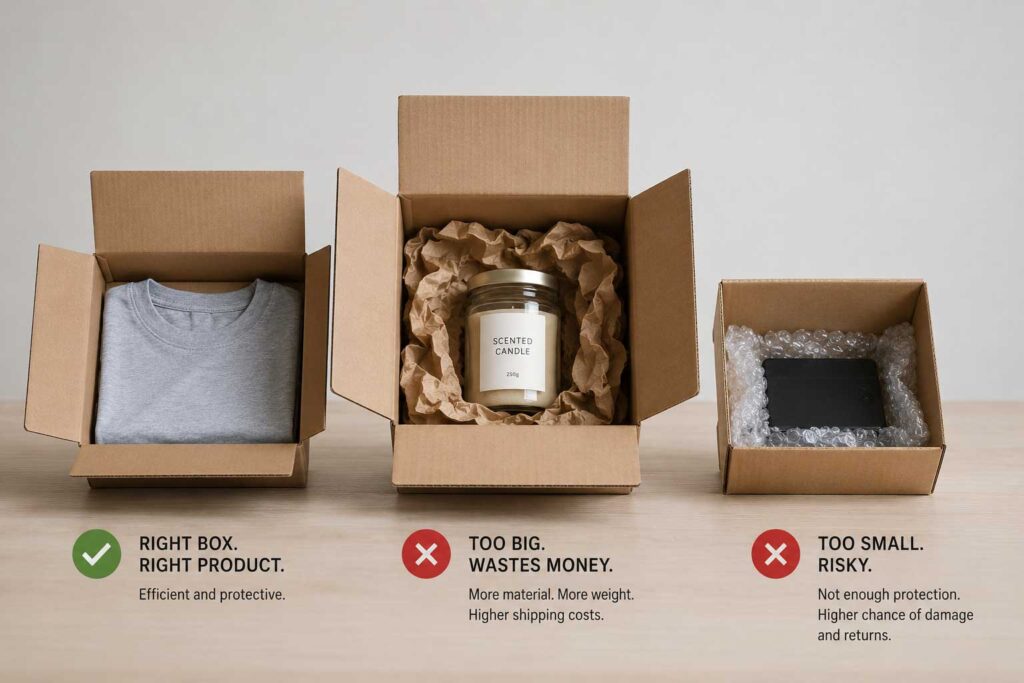
Here’s something I see all the time.
A business finds a box that works for one product. It fits. It ships fine. No complaints. So they use that same box for everything.
Makes sense on the surface. Fewer SKUs to manage. Simpler ordering process. Less thinking involved.
But here’s the problem different products need different levels of protection. And using the same box across the board almost always means you’re either overspending on some products or under-protecting others.
Think about it this way.
A T-shirt doesn’t need the same box strength as a glass jar. A small gift doesn’t need the same protection as an electronic device. A lightweight retail product doesn’t need double wall packaging. But a fragile candle absolutely might — especially if it needs inserts to keep it from shifting during transit.
The wrong box is a problem either way. Too strong and you’re wasting money on material and weight. Too weak and you’re risking damage, returns, and the kind of customer experience that ends up in a one-star review.
The best packaging is always designed around the product. Not the other way around.
Before You Choose: Follow the Product Journey
The easiest way to choose between single wall and double wall corrugated boxes is to stop looking at the box first and look at the product journey instead.
A product does not just sit inside a box. It moves.
It may be packed by your team, stacked in your warehouse, loaded into a van, handled by a courier, moved through a depot, placed under other parcels, delivered to a customer, opened at home, returned, or stored again.
Every step adds pressure.
That is why the right box strength depends on the journey, not just the product size.
Ask yourself:
- Will the product be shipped through a courier network?
- Will the box be stacked in storage?
- Will the product be handled many times before delivery?
- Is the item fragile, sharp, heavy, or high-value?
- Does the product need to arrive looking premium?
- Will the customer reuse the box for returns?
- Does the box need inserts or internal support?
A lightweight item that goes straight to a customer may only need single wall packaging. A fragile glass product going through courier handling may need double wall packaging, inserts, and a tighter fit.
This is why packaging should never be guessed. The better you understand the journey, the easier it becomes to choose the correct strength.
For a wider buying process, you can also read our guide on how to choose the right corrugated box.
Wall Strength Is Important, But It Is Not the Only Factor
Single wall and double wall are important choices, but wall count is only one part of the packaging decision.
A double wall box can still fail if it is too large, poorly closed, badly packed, or overloaded. A single wall box can perform well if it is correctly sized, made from suitable board, and used for the right product.
Box performance depends on several things working together:
- Board grade
- Flute type
- Box size
- Product weight
- How tightly the product fits
- Whether inserts are used
- How the box is sealed
- How the box is stored
- How far the parcel travels
This is where many businesses make a mistake. They ask, “Should I use single wall or double wall?” when the better question is, “What level of protection does this product need through its full journey?”
Wall count matters. But it works best when the rest of the packaging is also right.
Understanding Flute Types in Single Wall and Double Wall Boxes
The flute is the wavy layer inside corrugated board. It gives the box its cushioning, thickness, and strength.
Different flute types affect how the box feels, prints, stacks, and protects. You do not need to know every technical detail, but understanding the basics helps you make a better choice.
E Flute
E flute is thinner and gives a smoother surface for printing. It is commonly used for branded mailer boxes, retail packaging, subscription boxes, cosmetic packaging, and premium ecommerce boxes.
It works well when you want packaging that looks neat but does not need heavy-duty strength.
E flute is useful for:
- Light ecommerce products
- Small retail items
- Cosmetic packaging
- Gift-style mailer boxes
- Printed branded packaging
B Flute
B flute gives more strength than E flute and is often used for general packaging. It offers good crush resistance and works well for retail, food packaging, and everyday shipping boxes.
B flute can be a good choice when you need a balance between strength and presentation.
C Flute
C flute is thicker and gives better cushioning. It is often used for shipping boxes and products that need more protection during transport.
If your box will be stacked, handled often, or shipped through courier networks, C flute can be useful.
BC Flute
BC flute is a common double wall option. It combines two flute layers, making the board much stronger and more suitable for heavier products, stacked boxes, industrial goods, and fragile items.
This is the kind of option you would consider when single wall is not enough.
EB Flute
EB flute is also a double wall option. It combines a smoother flute with a stronger flute, giving both print quality and strength.
It can work well for premium ecommerce packaging, display packaging, and branded boxes that still need better protection.
When Single Wall Corrugated Boxes Are the Smarter Choice
Single wall boxes are not a weaker choice by default. They are the smarter choice when the product does not need double wall protection.
Many businesses waste money by using double wall boxes for products that only need single wall. That may feel safer, but it increases material use, storage space, and sometimes shipping weight without improving the customer experience.
Single wall boxes are usually suitable when:
- The product is lightweight
- The product is not fragile
- The box will not be heavily stacked
- The delivery route is simple
- The product already has inner protection
- The packaging is mainly for ecommerce presentation
- The product does not have sharp edges or pressure points
For example, clothing does not usually need double wall packaging. A hoodie, T-shirt, scarf, or soft accessory may only need a good mailer box or postage box.
Small cosmetics may also work well in single wall packaging if the product already has a strong primary container. The same can apply to accessories, paper goods, lightweight gifts, and subscription products.
The goal is not to buy the strongest possible box. The goal is to buy the right box.
If single wall protects the product properly, it is often the better business decision.
When Double Wall Corrugated Boxes Are Worth the Extra Cost
Double wall boxes cost more because they use more material and are stronger. But in the right situation, the extra cost is easy to justify.
Double wall is worth considering when the product is:
- Heavy
- Fragile
- High-value
- Likely to be stacked
- Stored for a long time
- Shipped long distance
- Handled by multiple carriers
- Packed with multiple items
- At risk of crushing or impact damage
Think about a glass candle jar. The product may be small, but it is breakable. If it moves inside the box or the parcel is dropped, the risk of damage increases.
Now think about electronics. They may need protection from impact, pressure, and movement. A weak box can make the whole order feel cheap, even if the product is expensive.
Double wall packaging is also useful for warehouse storage. If boxes are stacked for weeks, the lower boxes need enough strength to hold weight without crushing.
So, while double wall is not always necessary, it is often the right choice when the cost of damage is higher than the cost of stronger packaging.
Single Wall vs Double Wall by Product Type
The best choice depends on the product. Here is a more practical breakdown for common business categories.
| Product Category | Best Option | Why |
|---|---|---|
| Clothing and soft goods | Single wall | Lightweight and usually not fragile |
| Small accessories | Single wall | Usually low weight and easy to protect |
| Cosmetics in strong containers | Single wall or single wall with inserts | Depends on bottle or jar material |
| Glass jars and bottles | Double wall with inserts | Fragile and at risk of movement |
| Candles | Double wall or strong single wall with insert | Glass and wax weight increase risk |
| Electronics | Double wall | Higher value and more sensitive to impact |
| Food delivery products | Single wall or double wall depending on weight | Needs practical handling and product support |
| Bulk wholesale items | Double wall | Often stacked, stored, and moved in quantity |
| Subscription boxes | Single wall for light items, double wall for fragile sets | Depends on product mix inside the box |
| Retail display packaging | Single wall for light products, double wall for heavier displays | Presentation and support both matter |
This table is only a guide. The final choice should still depend on product size, weight, fragility, shipping method, and order quantity.
How Inserts Can Change the Decision
Sometimes the answer is not simply single wall or double wall. Sometimes the missing piece is an insert.
An insert keeps the product in place inside the box. It stops movement, separates items, improves presentation, and reduces the chance of products hitting each other.
Inserts are useful for:
- Bottles
- Glass jars
- Candles
- Cosmetics
- Gift sets
- Electronics
- Subscription boxes
- Multiple products in one box
A single wall box with the right insert can sometimes perform better than a double wall box with too much empty space.
That is an important point.
The product should not be allowed to move freely inside the box. If it does, the wall strength alone may not protect it.
For fragile or multi-item products, mailer boxes with inserts can give a better balance of protection and presentation.
Use inserts when they solve a real problem. Do not add them just because they look nice. A good insert should hold the product, improve the unboxing experience, or reduce damage risk.
Why Box Size Can Matter More Than Box Thickness
A thicker box is not always a safer box.
If the box is too large, the product can move around during delivery. That movement creates impact inside the box, even if the outside board is strong.
A right-sized single wall box may protect better than an oversized double wall box.
Oversized boxes can cause:
- More product movement
- More filler material
- Higher shipping costs
- Wasted storage space
- Poor unboxing experience
- More packaging waste
A correctly sized box helps the product stay stable.
This is especially important for ecommerce brands. Customers notice when a small product arrives in a huge box full of filler. It feels careless and wasteful.
So before choosing double wall, check the size first. You may not need a thicker box. You may simply need a better-fitting box.
For custom sizes and material guidance, you can explore custom corrugated boxes UK.
How Shipping Method Affects Box Strength
The way your product is shipped affects the box you need.
A product delivered locally by your own team may not need the same box as a parcel sent through a courier network. Courier parcels can be stacked, sorted, pushed, dropped, and handled by several people before delivery.
That does not mean every courier parcel needs double wall. It means you should think about the risk.
Use single wall when:
- The product is light
- The journey is short
- The item is not fragile
- The box fits properly
- The product has inner protection
Use double wall when:
- The product is heavy
- The journey is longer
- The item is fragile
- The box will be stacked
- The product has a high return cost
Shipping risk is not only about distance. It is also about how many times the box is handled.
A short trip with rough handling can be worse than a long trip with careful handling. Since you cannot control every step after dispatch, packaging should be chosen with realistic handling in mind.
How Storage and Stacking Affect the Decision
Storage is often ignored when businesses choose packaging.
But if boxes are stored in a warehouse, stockroom, or fulfilment centre, stacking strength matters.
Single wall boxes can work well for light stock. But if products are heavy or boxes are stacked high, the lower boxes may start to crush or lose shape.
Double wall boxes offer more stacking support.
Think about:
- How long boxes will be stored
- Whether boxes will be stacked
- How much weight will sit on the lower boxes
- Whether the storage area is dry
- Whether the boxes will be moved often
Moisture also matters. Corrugated board is paper-based, so damp storage can weaken the box over time. Even a double wall box can lose strength if it is stored badly.
Keep boxes dry, flat-packed where possible, and away from heavy pressure before use.
The Cost Side: Do Not Only Compare Unit Price
When comparing single wall and double wall boxes, many businesses only look at the unit price.
That is a mistake.
The real cost of packaging includes more than the price per box.
You should also think about:
- Damage rate
- Return costs
- Replacement orders
- Customer support time
- Courier claims
- Storage space
- Shipping weight
- Brand reputation
Single wall is cheaper upfront. Double wall is more expensive upfront. But the better option is the one that reduces total business cost.
If your products are light and safe, single wall can save money without causing problems.
If your products are fragile, double wall can save money by preventing damage.
This is why wholesale packaging decisions should be based on product risk, not just box price.
For more cost planning, read our guide on custom corrugated boxes wholesale.
Sustainability: Strong Enough Without Overpacking
Sustainable packaging is not about always choosing the lightest box. It is about choosing the right amount of packaging for the product.
If you overpack, you waste material.
If you underpack, the product may arrive damaged. Then you may need replacement products, extra deliveries, and more packaging. That creates waste too.
So the sustainable choice is the box that protects properly without using unnecessary material.
A good approach is:
- Use single wall where it is enough
- Use double wall where the product genuinely needs it
- Choose the correct box size
- Avoid unnecessary filler
- Use inserts only when they reduce movement or damage
- Keep packaging clean and easy to recycle where possible
GOV.UK reported that paper and cardboard had the highest UK packaging recycling rate in 2024 at 86.4%, which shows why paper-based packaging remains important for UK businesses. You can check the official figures in the UK statistics on waste.
Customers also need clear recycling instructions. Recycle Now advises removing loose strands of sticky tape from cardboard boxes where possible before recycling. You can link customers to local guidance or print simple messages such as “Flatten before recycling” or “Remove non-paper inserts before recycling.”
For more detail, read our guide on are corrugated boxes recyclable in the UK.
EPR and Why Packaging Records Matter
UK businesses should also be aware of Extended Producer Responsibility for packaging, often called EPR.
GOV.UK explains that organisations affected by EPR may need to report packaging data and pay fees based on that data. This makes packaging records more important for businesses that supply, import, or sell packaged products in the UK.
This is not legal advice, but it is a useful reminder: packaging choices should be organised, measured, and recorded.
If you regularly order corrugated boxes, keep details such as:
- Box size
- Material type
- Single wall or double wall
- Order quantity
- Packaging weight
- Supplier information
- Whether inserts are used
- Whether the packaging is printed or plain
These records can help you make better buying decisions and may also support packaging data reporting if your business is affected.
For official guidance, check GOV.UK EPR packaging guidance. You can also read our simple business guide on corrugated packaging and EPR in the UK.
How to Brief Your Packaging Supplier
A good supplier can recommend the right board strength, but they need the right information first.
Do not only send your box size. Send product details too.
Before requesting a quote, prepare:
- Product dimensions
- Product weight
- Product material
- Whether the product is fragile
- How the product will be shipped
- Whether the box will be stacked
- Whether the product needs inserts
- Whether you need printing
- Order quantity
- Delivery deadline
A supplier cannot choose the right strength from size alone. A small glass jar may need stronger packaging than a larger clothing item.
The better your brief, the better your quote will be.
Here is a simple example:
Poor brief: “I need a box for a candle.”
Better brief: “I need a corrugated box for a 300g glass candle jar. It will be shipped by courier in the UK. I want logo printing and an insert to keep the jar secure.”
The second brief gives enough detail to recommend a proper solution.
Practical Scenarios: Which Box Should You Pick?
Here are some real-world style scenarios to make the decision easier.
Scenario 1: Clothing Brand Shipping T-Shirts
Single wall is usually enough. The product is light, flexible, and not fragile. A branded mailer box or postage box can work well.
Scenario 2: Candle Brand Shipping Glass Jars
Double wall or strong single wall with inserts may be needed. The product is fragile, has weight, and can break if it moves inside the box.
Scenario 3: Subscription Box With Mixed Products
It depends on the product mix. If everything is light, single wall may work. If the box includes glass, liquid, or fragile items, inserts and stronger board may be needed.
Scenario 4: Electronics Business Shipping Devices
Double wall is usually safer. Electronics are higher value and need better protection against impact and pressure.
Scenario 5: Retail Display Packaging
Single wall can work for light display products. Double wall may be needed for heavier display units or bulk presentation boxes.
Scenario 6: Food Business Sending Heavy Items
Choose based on weight, moisture risk, delivery method, and product shape. Lightweight food packaging may only need single wall. Heavy jars, frozen goods, or stacked boxes may need stronger board.
Final Decision Table
Use this table as a quick guide before you order.
| Question | If Yes | Likely Choice |
|---|---|---|
| Is the product lightweight? | Yes | Single wall |
| Is the product fragile? | Yes | Double wall or inserts |
| Will the box be stacked? | Yes | Double wall |
| Is the product high-value? | Yes | Double wall |
| Is the box mainly for retail display? | Yes | Single wall or display-style board |
| Will the product be shipped by courier? | Yes | Single wall for light items, double wall for fragile/heavy items |
| Does the product move inside the box? | Yes | Better sizing or inserts needed |
| Are you using more material than needed? | Yes | Review size, board grade, and wall type |
Best Simple Rule for UK Businesses
Here is the simplest way to make the decision.
Use single wall when the product is light, low-risk, and easy to ship.
Use double wall when the product is heavy, fragile, high-value, stacked, or difficult to replace.
Use inserts when the product needs to stay in position.
Use a custom size when movement inside the box is the main problem.
That is the whole decision in plain English.
The goal is not to overprotect every product. The goal is to protect each product properly.
For packaging made around your actual product size, strength, and branding needs, explore corrugated packaging boxes from PackagingX.
Final Thoughts
Here’s the bottom line.
Single wall and double wall corrugated boxes both have their place — and neither one is universally better than the other.
Single wall is your go-to for lighter products, standard ecommerce orders, retail packaging, and general use. It’s cost-effective, widely available, and strong enough for the majority of everyday shipping situations.
Double wall is the right move when your product is heavier, more fragile, more valuable, or going to face tougher conditions during transit or storage. You’ll pay a little more, but you’ll save a lot more in damage costs, returns, and brand reputation down the line.
The decision really comes down to four things — your product weight, how fragile it is, how it’s being shipped, and what kind of storage conditions it’ll face before it reaches your customer.
Get those four things right and choosing between single wall and double wall becomes an easy call.
If you want packaging built specifically around your product — the right size, the right strength, the right finish — explore our corrugated packaging boxes at PackagingX and request a free quote. No guesswork. Just packaging that actually works.
FAQs
What is the difference between single wall and double wall corrugated boxes?
Single wall corrugated boxes have one fluted layer between two liners. Double wall corrugated boxes have two fluted layers and three liners. Double wall boxes are stronger and better for heavier, fragile, or stacked products.
Are double wall boxes better than single wall boxes?
Double wall boxes are better when you need extra strength and protection. However, single wall boxes are still suitable for lighter products, standard ecommerce packaging, and general use. The better option depends on your product.
Are single wall boxes good for shipping?
Yes, single wall boxes can be good for shipping lightweight and non-fragile products. For heavier, fragile, or high-value products, double wall boxes are usually safer.
When should I use double wall corrugated boxes?
Use double wall corrugated boxes for heavy items, fragile products, glass jars, candles, electronics, bulk orders, warehouse storage, and products that may be stacked or handled roughly during delivery.
Do double wall boxes cost more?
Yes, double wall boxes usually cost more because they use more material and provide extra strength. However, they can help reduce damage, returns, and replacement costs for products that need better protection.
Which corrugated box is best for ecommerce?
For lightweight ecommerce products, single wall boxes may be enough. For fragile, heavy, or premium products, double wall boxes or corrugated boxes with inserts are usually better.
More FAQs About Single Wall and Double Wall Corrugated Boxes
Can a single wall box protect fragile products?
Sometimes, but only if the product is light, the box fits well, and inserts or cushioning are used. For glass, electronics, candles, and other fragile products, double wall is usually safer.
Is double wall always the best choice for shipping?
No. Double wall is best for heavy, fragile, high-value, or stacked products. For lightweight non-fragile products, single wall can be strong enough and more cost-effective.
Can inserts replace double wall packaging?
Inserts can improve protection by stopping movement inside the box, but they do not always replace the need for stronger board. For fragile and heavy products, you may need both double wall packaging and inserts.
Does box size affect strength?
Yes. A correctly sized box protects better because it reduces product movement. An oversized double wall box can still perform badly if the product moves around inside.
Which is better for branded ecommerce packaging?
Single wall mailer boxes are often enough for light ecommerce products. Double wall packaging may be better for fragile or premium products that need stronger protection during delivery.
Are single wall boxes cheaper to store?
Usually, yes. Single wall boxes are thinner and take up less space when stored flat. Double wall boxes are thicker, so they may need more storage space.
Do double wall boxes increase delivery costs?
They can, depending on size, weight, and courier pricing. Double wall boxes use more material, so they may be slightly heavier. However, the extra protection can be worth it for fragile or heavy items.
Can both single wall and double wall boxes be recycled?
Yes, both are generally recyclable when clean, dry, and free from heavy contamination or difficult coatings. Customers should follow local recycling rules.
How do I know if my product needs double wall?
Choose double wall if your product is heavy, fragile, expensive, stacked in storage, shipped long distance, or likely to be handled roughly during delivery.
Can PackagingX help me choose the right wall strength?
Yes. PackagingX can help you choose the right size, board strength, printing, inserts, and finish based on your product and delivery needs.